
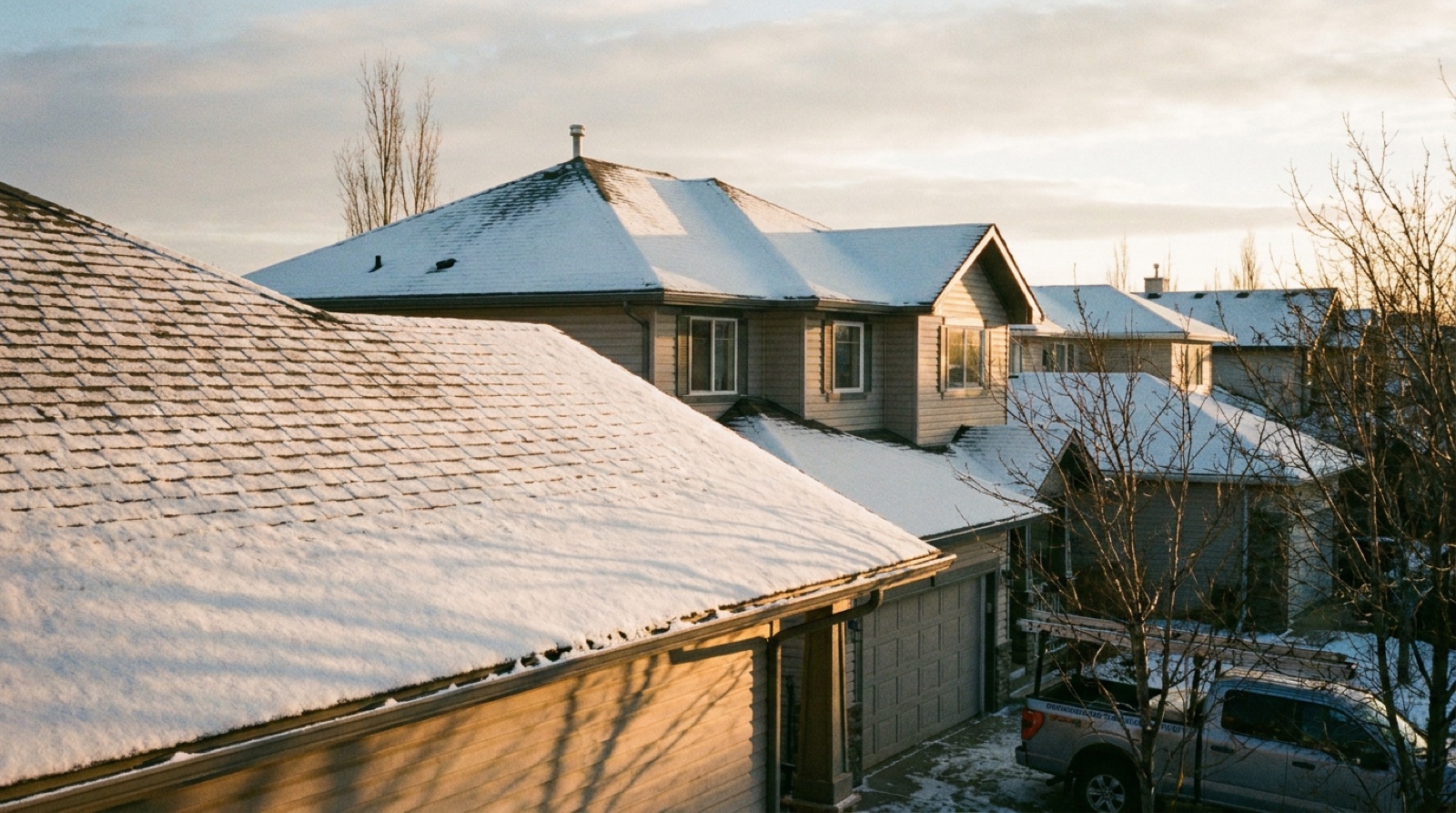
Most homes do not need snow cleared off the roof every winter. You should remove it when accumulation passes roughly 60 cm of settled snow, when ice has built up in layers, or when you see any sign of structural stress inside the house.
Below those points, snow on a sloped asphalt roof is usually just snow. Above them, weight becomes a real problem, and so does the meltwater that gets trapped behind ice at the eaves.
Snow Weight Is About Density, Not Depth
A metre of dry January powder can weigh less than 30 cm of the heavy wet snow that falls in late March. Depth alone tells you almost nothing.
Here is roughly what each type weighs per square foot of roof, for every 30 cm (about one foot) of depth.
| Snow type | Weight per sq ft | On a 1,500 sq ft roof |
|---|---|---|
| Fresh dry powder | About 5 lb | About 7,500 lb |
| Settled snow | 10 to 15 lb | 15,000 to 22,500 lb |
| Packed or wet snow | About 20 lb | About 30,000 lb |
| Solid ice | About 57 lb | About 85,000 lb |
Homes built to current Alberta code in the Edmonton area are designed for a roof snow load in the range of 20 to 30 lb per square foot. Older homes, additions, carports and garages built without permits often are not.
That is why layered snow matters so much. A crust of ice under 40 cm of new snow can put an ordinary bungalow past its design load without the depth looking alarming from the driveway.
Thresholds Worth Acting On
- More than 60 cm of settled snow on a sloped roof, especially after a thaw and refreeze cycle
- More than 30 cm on a flat or low slope roof, which has no natural shedding at all
- Any visible ice layer more than a few centimetres thick
- Drifts in valleys, behind chimneys, or against a second storey wall, where snow can pile two or three times deeper than the rest of the roof
Warning Signs You Should Never Ignore
Structural stress shows up inside the house before the roof fails. If you notice any of these during a heavy Edmonton winter, stop and get the roof looked at.
- Doors or windows that suddenly stick or will not latch
- New cracks in drywall, particularly above door frames
- Sagging ceiling lines or a visible dip in the roof ridge
- Creaking, popping or cracking sounds from the attic or ceiling
- Water staining on interior ceilings or around light fixtures
These call for immediate action, not a spring inspection. Our emergency response crews handle overloaded and actively leaking roofs across Edmonton, Leduc and Sherwood Park through the winter.
Ice Dams Are the More Common Problem
Far more Alberta homes are damaged by ice dams than by collapse. The mechanism is simple and it repeats every winter.
Heat escaping the attic melts snow on the upper part of the roof. That water runs down to the cold overhang, refreezes, and builds a ridge of ice that blocks everything behind it.
The trapped meltwater then backs up under the shingles. Shingles shed water downhill, so once water is moving sideways or uphill it finds the deck, the insulation and eventually the ceiling.
What Actually Prevents Them
Clearing the bottom 1 to 2 metres of snow from the eaves removes the fuel for the dam. Longer term, the fix is attic insulation and ventilation so the roof deck stays cold.
Blocked or sagging troughs make it worse by holding standing ice at the roof edge. If yours failed last winter, sorting out the eavestrough and soffit system is usually cheaper than repeated interior repairs.
How to Remove Roof Snow Safely
From the Ground
A roof rake with a telescoping handle is the right tool for most homeowners. Pull snow down in strips, working from the edge upward, and stand off to the side so nothing lands on you.
Leave a few centimetres of snow on the shingles. Scraping down to the surface in cold weather chips granules off asphalt and shortens the life of the roof.
What Not to Do
- Do not climb onto a snow covered roof. Hidden ice under snow is the leading cause of winter falls at Alberta homes.
- Do not chip at ice with a hammer, axe or chisel. You will puncture the shingles and the underlayment beneath them.
- Do not use salt or ice melt on shingles. It corrodes flashing and metal fasteners.
- Do not rake near power lines. Aluminium handles and overhead service drops are a fatal combination.
Calcium chloride in a fabric sleeve, laid across the dam rather than thrown loose, is a reasonable emergency measure to open a channel for meltwater.
Flat and Low Slope Roofs Are Different
Nothing slides off a flat roof. Snow sits, compresses, absorbs meltwater and gets heavier every week until it is removed.
Drains and scuppers also freeze, so a warm spell can leave standing water on top of the accumulated snow load. Most commercial and low slope buildings in the Edmonton area should be cleared once accumulation reaches 30 cm, and drains checked after every thaw.
When to Bring in a Crew
Call a contractor if the roof is steep, two storeys or higher, has significant ice buildup, or if you are seeing interior warning signs. Professional snow and ice removal uses fall protection, steam equipment for ice rather than tools that gouge, and does not leave you with damage that surfaces in April.
It is also worth having someone check for existing damage before the snow arrives. Cracked flashing or lifted shingles that survive a dry fall will leak the moment ice dams form, and a repair booked in advance costs far less than the emergency version.
If snow is stacking up and you are not sure whether it is a problem, get in touch for an assessment and we will tell you straight whether it needs clearing.